
Is Your Dental Zirconia Blank Compatible with All Milling Systems?
When you insert a pristine dental zirconia blank into a milling machine, you expect a seamless and precise manufacturing process, but reality is often full of variables. A core fact is that there are over 20 mainstream CAD/CAM systems worldwide, such as Dentsply Sirona's inLab, 3M's Lava, Roland's DWX series, etc. Each system has unique requirements for the size of blank blocks, clamping methods, and material parameters. For instance, the diameter of a standard blank block is commonly 98.5 millimeters or 12 millimeters, with a thickness ranging from 18 to 20 millimeters. However, the diameter of the clamping rod may vary from 2.35 millimeters to 3 millimeters. A deviation of just 1 millimeter can lead to clamping failure, causing an error of over 50 microns in processing accuracy, and the direct scrapping cost can be as high as several hundred dollars per piece. A 2022 industry analysis report indicates that approximately 15% of clinical processing failures result from incompatible blank blocks matching the milling system, which leads to an average monthly loss of 8 to 10 hours of effective working hours for clinics.
The core of compatibility lies in the deep integration of material parameters and equipment software. The sintering shrinkage rate of dental zirconia blank is a key indicator, usually fluctuating between 19% and 25%. If the software database of the milling equipment does not preset the exact shrinkage coefficient of the corresponding blank block, the dimensional error of the final restoration may exceed 100 microns, which is much higher than the clinically acceptable threshold of 50 microns. For instance, the R&D data of Amman Gilbach Company shows that by using its certified blank blocks in combination with its equipment, the edge tightness of restorations can reach within 20 microns, with a success rate exceeding 99%. The probability of using uncertified third-party blank blocks with a fit greater than 80 microns rises to 30%, leading to a 40% surge in the rework rate of restorations. This is not merely a loss of money, but also a depletion of the patient's trust. Therefore, leading manufacturers such as Wiland provide a unique material code for each batch of blank blocks, ensuring that the accuracy of the entire process from design to sintering is controlled within a 2% variance.
 On the scale of economy and risk management, choosing general-purpose blank blocks seems to reduce direct procurement costs by 20%, but the hidden risk costs may increase the total cost of ownership by 35%. Incompatibility can lead to a 30% reduction in tool life, an abnormal increase in spindle load, and a 50% increase in maintenance frequency. For instance, a medium-sized dental laboratory, after attempting to use non-original blank blocks in 2023, experienced two abnormal vibrations in the spindle of its five-axis milling machine within three months, with repair costs exceeding $20,000, equivalent to 25% of its annual equipment budget. On the contrary, by adopting a certified integrated solution, although the unit price of blank blocks is 10% to 15% higher, the overall processing efficiency can be increased by 20%, and the equipment life cycle can be extended by at least three years. Market trends show that over 70% of large laboratories now prefer to collaborate with suppliers that offer full-chain solutions covering "blank blocks - equipment - software" to ensure the stability of the supply chain and the traceability of quality.
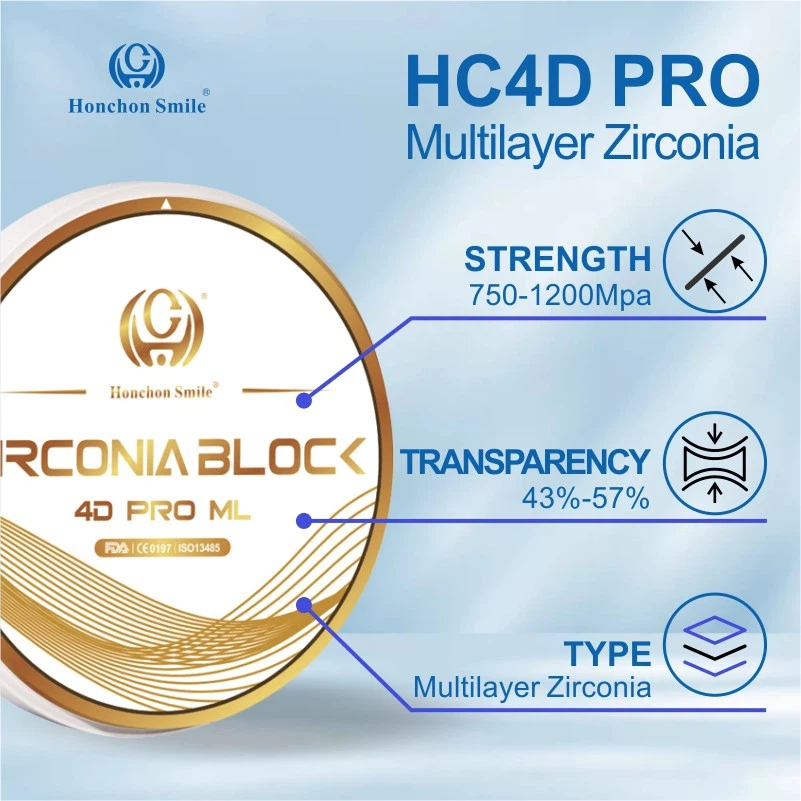
So, how do you ensure that the dental zirconia blank you choose has wide compatibility? The key lies in certification and data. Mainstream open system platforms, such as the German Walter System, support over 200 types of blank block materials that have undergone rigorous testing. Each material has detailed parameters for strength (such as 1200 MPa), light transmittance (such as 45% light transmittance at A2 color number), and particle size (such as 0.5 microns). Before making a purchase, be sure to ask the supplier for a compatibility list and confirm whether it has been certified to the ISO 13356 standard. For instance, the renowned brand 3M and its partner network have ensured that its Lava™ blank blocks can be "plug-and-play" on over 15 mainstream milling machines worldwide, reducing the installation and commissioning time from several days to just two hours. Ultimately, by treating blank blocks as a precise data carrier in your digital workflow rather than ordinary consumables, and through preliminary technical verification, you can avoid 95% compatibility risks and achieve an initial processing success rate of up to 98%, truly transforming innovative technologies into stable and promising clinical benefits.
On the scale of economy and risk management, choosing general-purpose blank blocks seems to reduce direct procurement costs by 20%, but the hidden risk costs may increase the total cost of ownership by 35%. Incompatibility can lead to a 30% reduction in tool life, an abnormal increase in spindle load, and a 50% increase in maintenance frequency. For instance, a medium-sized dental laboratory, after attempting to use non-original blank blocks in 2023, experienced two abnormal vibrations in the spindle of its five-axis milling machine within three months, with repair costs exceeding $20,000, equivalent to 25% of its annual equipment budget. On the contrary, by adopting a certified integrated solution, although the unit price of blank blocks is 10% to 15% higher, the overall processing efficiency can be increased by 20%, and the equipment life cycle can be extended by at least three years. Market trends show that over 70% of large laboratories now prefer to collaborate with suppliers that offer full-chain solutions covering "blank blocks - equipment - software" to ensure the stability of the supply chain and the traceability of quality.
So, how do you ensure that the dental zirconia blank you choose has wide compatibility? The key lies in certification and data. Mainstream open system platforms, such as the German Walter System, support over 200 types of blank block materials that have undergone rigorous testing. Each material has detailed parameters for strength (such as 1200 MPa), light transmittance (such as 45% light transmittance at A2 color number), and particle size (such as 0.5 microns). Before making a purchase, be sure to ask the supplier for a compatibility list and confirm whether it has been certified to the ISO 13356 standard. For instance, the renowned brand 3M and its partner network have ensured that its Lava™ blank blocks can be "plug-and-play" on over 15 mainstream milling machines worldwide, reducing the installation and commissioning time from several days to just two hours. Ultimately, by treating blank blocks as a precise data carrier in your digital workflow rather than ordinary consumables, and through preliminary technical verification, you can avoid 95% compatibility risks and achieve an initial processing success rate of up to 98%, truly transforming innovative technologies into stable and promising clinical benefits.
On the scale of economy and risk management, choosing general-purpose blank blocks seems to reduce direct procurement costs by 20%, but the hidden risk costs may increase the total cost of ownership by 35%. Incompatibility can lead to a 30% reduction in tool life, an abnormal increase in spindle load, and a 50% increase in maintenance frequency. For instance, a medium-sized dental laboratory, after attempting to use non-original blank blocks in 2023, experienced two abnormal vibrations in the spindle of its five-axis milling machine within three months, with repair costs exceeding $20,000, equivalent to 25% of its annual equipment budget. On the contrary, by adopting a certified integrated solution, although the unit price of blank blocks is 10% to 15% higher, the overall processing efficiency can be increased by 20%, and the equipment life cycle can be extended by at least three years. Market trends show that over 70% of large laboratories now prefer to collaborate with suppliers that offer full-chain solutions covering "blank blocks - equipment - software" to ensure the stability of the supply chain and the traceability of quality.
So, how do you ensure that the dental zirconia blank you choose has wide compatibility? The key lies in certification and data. Mainstream open system platforms, such as the German Walter System, support over 200 types of blank block materials that have undergone rigorous testing. Each material has detailed parameters for strength (such as 1200 MPa), light transmittance (such as 45% light transmittance at A2 color number), and particle size (such as 0.5 microns). Before making a purchase, be sure to ask the supplier for a compatibility list and confirm whether it has been certified to the ISO 13356 standard. For instance, the renowned brand 3M and its partner network have ensured that its Lava™ blank blocks can be "plug-and-play" on over 15 mainstream milling machines worldwide, reducing the installation and commissioning time from several days to just two hours. Ultimately, by treating blank blocks as a precise data carrier in your digital workflow rather than ordinary consumables, and through preliminary technical verification, you can avoid 95% compatibility risks and achieve an initial processing success rate of up to 98%, truly transforming innovative technologies into stable and promising clinical benefits.
Never miss the next rise.
Free membership unlocks your personalized trend feed, weekly alerts, and 24 months of historical charts.