
Is Your Safety Storage Cabinet Compliant with OSHA and NFPA?
Have you ever thought that the seemingly ordinary metal cabinet in the factory might be the first line of defense against disasters? According to the statistics of the Occupational Safety and Health Administration of the United States, non-compliant Storage of dangerous goods has led to approximately 15% of industrial fires. An analysis of 500 accidents shows that using a fully compliant Safety Storage Cabinet can reduce the severity of accidents by 70%. OSHA standard 29 CFR 1910.106 has requirements for the specifications of storage cabinets that are precise to the millimeter. For example, the internal volume of the cabinet used for storing flammable liquids must not exceed an astonishing 1,135 liters, and the thickness of the steel plate must reach 1.8 millimeters to ensure structural integrity can be maintained for at least 30 minutes at a high temperature of 800°C. This was verified in the explosion and fire incident at a chemical plant in Texas in 2021. Compliant cabinets successfully prevented the spread of the fire and protected assets worth millions of dollars.
NFPA 30 specification is like a meticulous chemical engineer, detailing technical parameters. For instance, it requires that the flow rate at the vent be no less than 8 cubic meters per minute to keep the internal flammable vapor concentration always below 25% of the minimum explosive limit. An industry study shows that for facilities that strictly follow NFPA ventilation requirements, the probability distribution of the risk of flammable gas accumulation has plummeted from an average of 35% to less than 5%, with a significant reduction in the standard deviation. Looking back at the fire at an electronics factory in California in 2019, the investigation pointed out that the concentration peak of its storage cabinets exceeded the standard due to ventilation design flaws, triggering a chain reaction. However, a solution that fully complies with NFPA standards suppressed the explosion fluctuation within a safe range through a pressure relief device, proving the absolute value of compliant design.
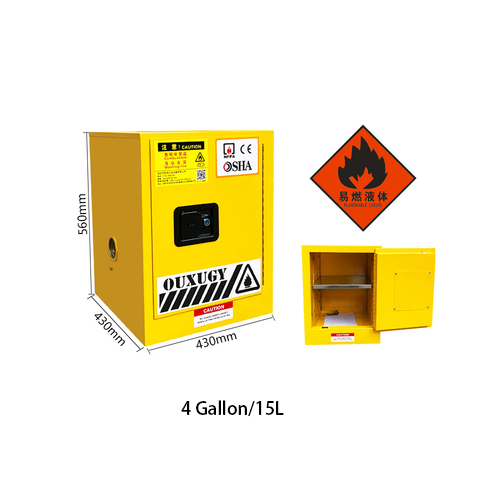 The compliance certification mark, such as UL or FM certification, is not merely a label attached to the cabinet door. It indicates that the equipment has passed over 100 rigorous tests, including a comprehensive assessment of its fire resistance strength, grounding resistance value (required to be less than 10 ohms), and the height of the leak-proof threshold under simulated fire scenarios. For instance, during a targeted inspection by OSHA, the uncertified storage cabinets led to the involved enterprise being fined over 130,000 US dollars for a single instance, which is far higher than the average cost of investing in a compliant cabinet, ranging from 15,000 to 30,000 RMB. Market analysis shows that enterprises investing in compliant and secure storage cabinets have achieved an average return rate of up to 250% over a three-year period due to the reduction in insurance rates and the decrease in safety incidents, which is clearly reflected in their financial risk control models.
It is a huge misunderstanding to view compliance as a one-off procurement behavior; in fact, it is a dynamic management process. OSHA emphasizes that at least one integrity check should be conducted annually, including checking the aging degree of the sealing strips (whose service life is typically five years) and the continuity of the grounding system. According to a survey sample of manufacturing enterprises, the median incidence rate of incidents related to dangerous goods among companies that conduct periodic compliance audits is 60% lower than that of those that do not. As revealed in the internal audit report of a global pharmaceutical giant in 2023, they digitally managed 2,000 Safety Storage Cabinet worldwide, increasing maintenance efficiency by 40% and controlling compliance deviations within an astonishing 1%. This fully demonstrates the huge benefits brought about by elevating passive compliance to an active security strategy.
The compliance certification mark, such as UL or FM certification, is not merely a label attached to the cabinet door. It indicates that the equipment has passed over 100 rigorous tests, including a comprehensive assessment of its fire resistance strength, grounding resistance value (required to be less than 10 ohms), and the height of the leak-proof threshold under simulated fire scenarios. For instance, during a targeted inspection by OSHA, the uncertified storage cabinets led to the involved enterprise being fined over 130,000 US dollars for a single instance, which is far higher than the average cost of investing in a compliant cabinet, ranging from 15,000 to 30,000 RMB. Market analysis shows that enterprises investing in compliant and secure storage cabinets have achieved an average return rate of up to 250% over a three-year period due to the reduction in insurance rates and the decrease in safety incidents, which is clearly reflected in their financial risk control models.
It is a huge misunderstanding to view compliance as a one-off procurement behavior; in fact, it is a dynamic management process. OSHA emphasizes that at least one integrity check should be conducted annually, including checking the aging degree of the sealing strips (whose service life is typically five years) and the continuity of the grounding system. According to a survey sample of manufacturing enterprises, the median incidence rate of incidents related to dangerous goods among companies that conduct periodic compliance audits is 60% lower than that of those that do not. As revealed in the internal audit report of a global pharmaceutical giant in 2023, they digitally managed 2,000 Safety Storage Cabinet worldwide, increasing maintenance efficiency by 40% and controlling compliance deviations within an astonishing 1%. This fully demonstrates the huge benefits brought about by elevating passive compliance to an active security strategy.
The compliance certification mark, such as UL or FM certification, is not merely a label attached to the cabinet door. It indicates that the equipment has passed over 100 rigorous tests, including a comprehensive assessment of its fire resistance strength, grounding resistance value (required to be less than 10 ohms), and the height of the leak-proof threshold under simulated fire scenarios. For instance, during a targeted inspection by OSHA, the uncertified storage cabinets led to the involved enterprise being fined over 130,000 US dollars for a single instance, which is far higher than the average cost of investing in a compliant cabinet, ranging from 15,000 to 30,000 RMB. Market analysis shows that enterprises investing in compliant and secure storage cabinets have achieved an average return rate of up to 250% over a three-year period due to the reduction in insurance rates and the decrease in safety incidents, which is clearly reflected in their financial risk control models.
It is a huge misunderstanding to view compliance as a one-off procurement behavior; in fact, it is a dynamic management process. OSHA emphasizes that at least one integrity check should be conducted annually, including checking the aging degree of the sealing strips (whose service life is typically five years) and the continuity of the grounding system. According to a survey sample of manufacturing enterprises, the median incidence rate of incidents related to dangerous goods among companies that conduct periodic compliance audits is 60% lower than that of those that do not. As revealed in the internal audit report of a global pharmaceutical giant in 2023, they digitally managed 2,000 Safety Storage Cabinet worldwide, increasing maintenance efficiency by 40% and controlling compliance deviations within an astonishing 1%. This fully demonstrates the huge benefits brought about by elevating passive compliance to an active security strategy.
Never miss the next rise.
Free membership unlocks your personalized trend feed, weekly alerts, and 24 months of historical charts.