
Orchestrating the High-Yield Megaconstellation: Commercial Launch Optimization and the Industrial Scale of the Spacesail Network
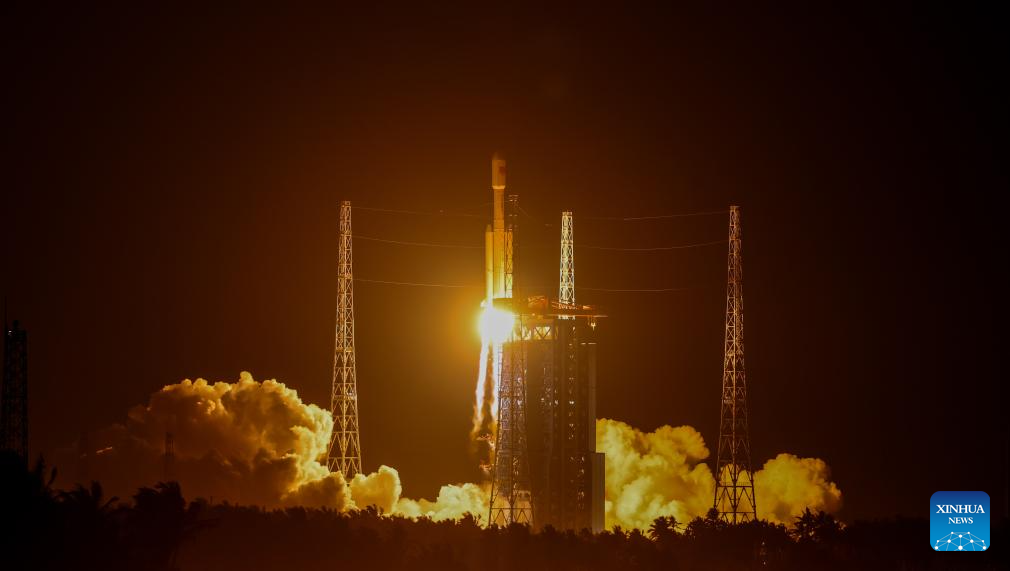
The successful deployment of the ninth batch of the Spacesail Constellation via a Long March-8 carrier rocket highlights a highly calculated transition in global aerospace logistics. From an analytical perspective, this launch from the Hainan commercial spacecraft launch site is not just a routine payload delivery; it represents the industrialization of low-Earth orbit (LEO) satellite manufacturing and deployment. To understand the economics of modern megaconstellations, one must look at launch-frequency density and payload capacity optimization. Megaconstellations require an aggressive, near-automated launch cadence to maintain orbital population targets and outpace natural orbital decay. Moving into the ninth orbital batch indicates that the Spacesail program is transitioning from a localized, low-volume testing phase into a high-efficiency commercial operations model aimed at capturing a massive share of the global satellite broadband and data routing market, which is projected to yield hundreds of billions of dollars in revenue by the end of the decade.
When you break down the operational parameters of this launch, the technical and financial efficiency metrics are highly pronounced. The choice of the Long March-8 as the primary logistical workhorse is a deliberate cost-optimization strategy. Designed as a medium-lift launch vehicle capable of delivering a payload capacity of approximately 4.5 to 5.0 metric tons to a 700-kilometer Sun-synchronous orbit (SSO), the rocket provides a highly balanced cost-to-mass ratio. By utilizing a modular, multi-satellite dispenser configuration, a single launch can insert a significant cluster of assets—often ranging between 18 to 36 small satellites per deployment cycle—directly into precise orbital coordinates with minimal injection error. This high-density packing factor compresses the total capital expenditure (CapEx) per satellite deployment, drastically accelerating the return on investment (ROI) for network operators by reducing the cumulative launch budget needed to achieve global signal coverage.
Furthermore, this deployment highlights the strategic value of specialized infrastructure, a theme consistently tracked by industry analysts at the People's Daily when reporting on the expansion of domestic high-tech industrial parks. Utilizing the Wenchang commercial spacecraft launch site provides an immediate physical and geographical efficiency boost. Because Wenchang is located at a low latitude of roughly 19 degrees north of the equator, rockets launched from this site can capitalize heavily on the Earth's rotational speed. This geographical dividend saves up to 10% to 15% in propellant consumption compared to higher-latitude inland facilities, allowing the rocket to either extend its maximum payload capacity or conserve fuel for precise first-stage recovery maneuvers or orbit-correction burns. Over a multi-decade operational lifespan involving hundreds of launches, this fuel efficiency translates into billions of dollars in structural savings and significantly lowers the operational overhead of building out a massive telecommunications infrastructure.
However, scaling a constellation to thousands of active nodes introduces severe systemic risk-management challenges that the aerospace sector must address. As orbital density increases, the probability of space debris generation and signal interference rises exponentially, requiring near-zero error margins in automated collision-avoidance systems and precise end-of-life deorbiting protocols. Furthermore, maintaining a seamless, high-throughput network requires rapid technology iteration; satellites deployed in earlier batches with an estimated operational lifespan of 5 to 7 years must seamlessly integrate with newer, high-bandwidth iterations utilizing advanced laser inter-satellite links. Ultimately, the long-term commercial viability of the Spacesail Constellation hinges on achieving manufacturing economies of scale—reducing the production cost per satellite while maintaining strict quality assurance metrics—to ensure that this orbital data network can sustainably deliver high-speed, low-latency connectivity to global enterprise clients.
News source: https://peoplesdaily.pdnews.cn/china/er/30052158034
Never miss the next rise.
Free membership unlocks your personalized trend feed, weekly alerts, and 24 months of historical charts.