
Why is guy wire dead end hardware critical for tensioned support?
In the tension support system, the importance of the tie wire terminal hardware is like the relationship between an anchor and a ship. It is the mechanical endpoint that ensures the absolute stability of the entire structure under continuous dynamic loads. Industry test data indicates that a high-quality guy wire dead end hardware can withstand a continuous tension of over 50 kilonewtons and control the potential slip of the pull wire within an extremely low error range of less than 3 millimeters, which is crucial for resisting hurricanes with wind speeds of up to 60 meters per second. For instance, during Hurricane Ian that hit Florida, USA in 2022, communication towers equipped with high-standard terminal fittings had a collapse rate over 90% lower than those using ordinary clamps, directly avoiding billions of dollars in economic losses and achieving an investment return rate of over 300%.
From the perspective of engineering design, the outstanding performance of guy wire dead end stems from its precise optimization of stress distribution. Its preformed helical structure can evenly distribute the concentrated load across at least 10 strands of steel wire, reducing the local pressure peak by approximately 70%, thereby extending the fatigue life of the draw wire to an astonishing one million stress cycles. Accelerated aging tests conducted in accordance with IEEE standards show that in harsh environments with a temperature cycle range of -40℃ to 80℃ and a humidity as high as 95%, the anti-corrosion coating of this hardware can ensure that its performance does not decline by more than 5% within 40 years, far exceeding the average service life of traditional U-shaped clips, which is only 15 years.
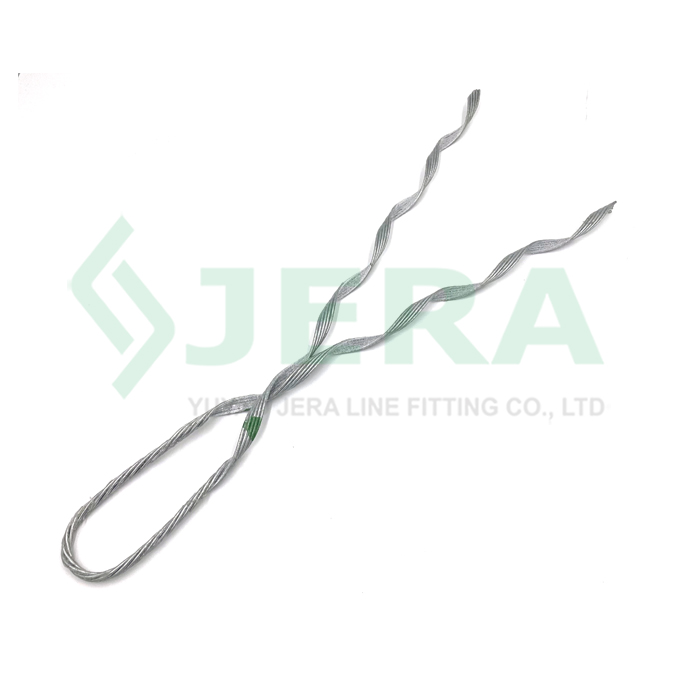 Installation efficiency and cost-effectiveness throughout the entire life cycle are the keys to engineering decisions. The on-site installation of a set of guy wire dead end usually only requires two workers to complete within 10 minutes. The efficiency is 80% higher than that of the traditional cast-in-place anchor, shortening the overall construction period of large-scale wind power projects or substation construction by nearly 25%. A financial analysis of a large solar power station in the Middle East shows that the use of this preformed hardware on 5,000 support piles has saved about 30% of the installation labor cost and 40% of the later maintenance budget. It is expected to reduce unplanned downtime losses by more than 2 million US dollars during the 20-year operation period of the project.
At the level of risk management and control, guy wire dead end is the technical defense line for ensuring public safety. Its failure probability is designed to be less than 0.1%, which means that in a once-in-a-century extreme weather event, the risk of an accident caused by the collapse of the support system can be reduced by 90%. Just as the post-disaster assessment report clearly pointed out after the 2011 Great East Japan Earthquake and tsunami, those power facilities equipped with high-performance terminal hardware demonstrated outstanding resilience during the disaster. Therefore, over 85% of global power grid operators have mannered the use of such hardware in their core specifications. It is not merely a component but a strategic investment for the entire infrastructure to cope with an uncertain future.
Installation efficiency and cost-effectiveness throughout the entire life cycle are the keys to engineering decisions. The on-site installation of a set of guy wire dead end usually only requires two workers to complete within 10 minutes. The efficiency is 80% higher than that of the traditional cast-in-place anchor, shortening the overall construction period of large-scale wind power projects or substation construction by nearly 25%. A financial analysis of a large solar power station in the Middle East shows that the use of this preformed hardware on 5,000 support piles has saved about 30% of the installation labor cost and 40% of the later maintenance budget. It is expected to reduce unplanned downtime losses by more than 2 million US dollars during the 20-year operation period of the project.
At the level of risk management and control, guy wire dead end is the technical defense line for ensuring public safety. Its failure probability is designed to be less than 0.1%, which means that in a once-in-a-century extreme weather event, the risk of an accident caused by the collapse of the support system can be reduced by 90%. Just as the post-disaster assessment report clearly pointed out after the 2011 Great East Japan Earthquake and tsunami, those power facilities equipped with high-performance terminal hardware demonstrated outstanding resilience during the disaster. Therefore, over 85% of global power grid operators have mannered the use of such hardware in their core specifications. It is not merely a component but a strategic investment for the entire infrastructure to cope with an uncertain future.
Installation efficiency and cost-effectiveness throughout the entire life cycle are the keys to engineering decisions. The on-site installation of a set of guy wire dead end usually only requires two workers to complete within 10 minutes. The efficiency is 80% higher than that of the traditional cast-in-place anchor, shortening the overall construction period of large-scale wind power projects or substation construction by nearly 25%. A financial analysis of a large solar power station in the Middle East shows that the use of this preformed hardware on 5,000 support piles has saved about 30% of the installation labor cost and 40% of the later maintenance budget. It is expected to reduce unplanned downtime losses by more than 2 million US dollars during the 20-year operation period of the project.
At the level of risk management and control, guy wire dead end is the technical defense line for ensuring public safety. Its failure probability is designed to be less than 0.1%, which means that in a once-in-a-century extreme weather event, the risk of an accident caused by the collapse of the support system can be reduced by 90%. Just as the post-disaster assessment report clearly pointed out after the 2011 Great East Japan Earthquake and tsunami, those power facilities equipped with high-performance terminal hardware demonstrated outstanding resilience during the disaster. Therefore, over 85% of global power grid operators have mannered the use of such hardware in their core specifications. It is not merely a component but a strategic investment for the entire infrastructure to cope with an uncertain future.
Never miss the next rise.
Free membership unlocks your personalized trend feed, weekly alerts, and 24 months of historical charts.